Saturday night in Belfast, what do you do? Hit the bars and clubs? A trip to the cinema or theatre in search of some culture?

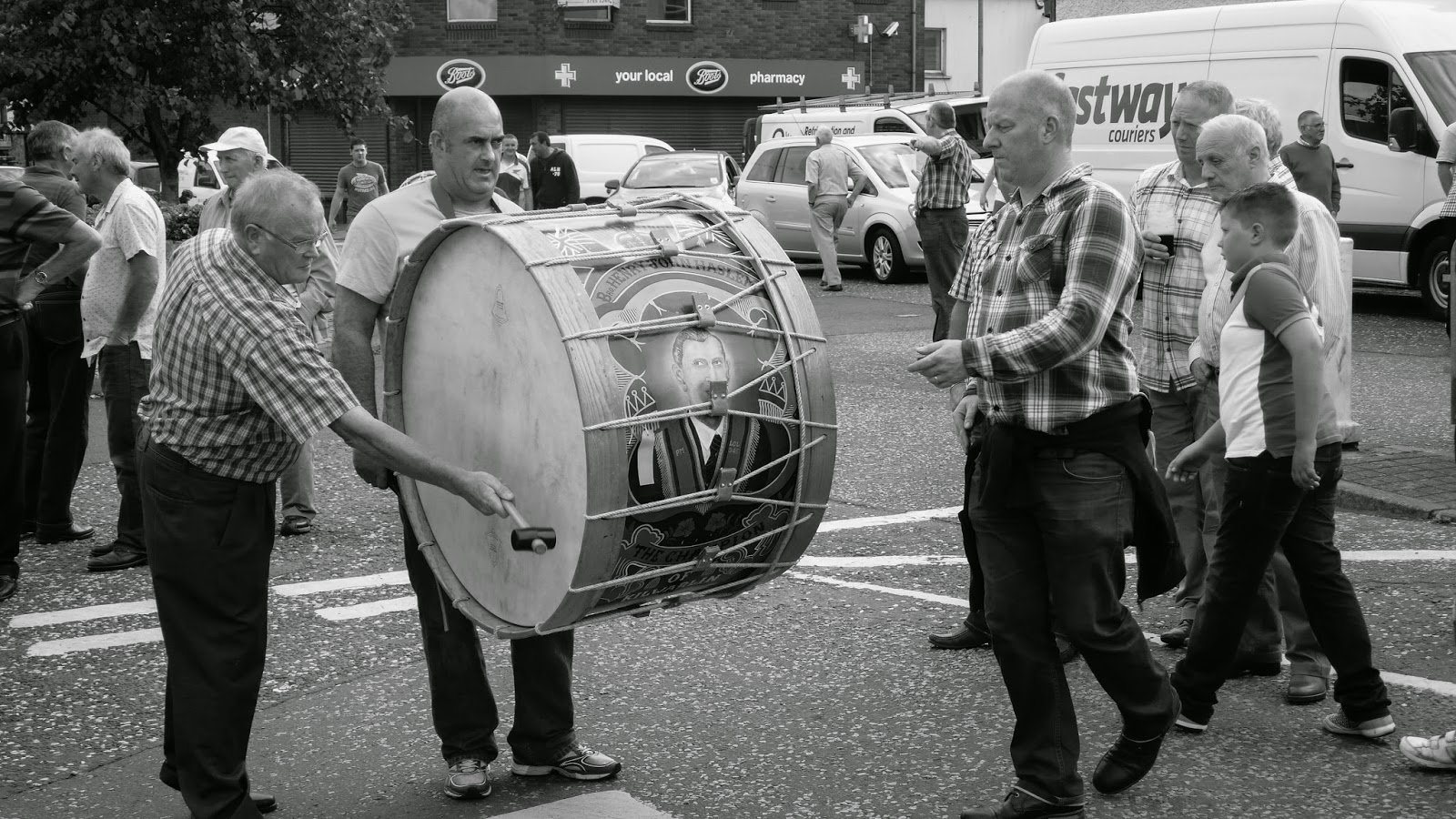
Well last Saturday I got in my car and headed to the town of Markethill, County Armagh to attend the famous (although you may have never of heard of it) Clady Night, drumming match. An evening of culture and music awaited.

In case you are unsure, a drumming match is when a group of lambeg drum aficionados gather together to beat their monstrous musical instruments for hours and hours and in the end one is crowned the winner. The drumming season runs from February until November. Events take place each Saturday night across the province and County Armagh, it's claimed, has the strongest tradition of any county in Northern Ireland.

There was very little information available online about the evening's events so I had to rely on the word of mouth of people who had attended before. The one thing that was repeated time and again was that there would be no drumming if it rained. Rain was forecast but at five o'clock the sun was shining in Belfast so I took my chance.

Crowds gather as the drums begin to beat 

There is something very tribal about the experience I encountered, and the noise that greeted me upon parking my car was like nothing else that I had heard before. The sound was generated from banging an individual lambeg with a curved cane stick and can reach 120 decibels. There were over fifty drums in Markethill on Saturday evening, I'm sure the sound must have carried across the county.

Although allegedly named after the Co. Antrim village of Lambeg, where it is reported that the first drum was constructed after King William stopped en route to the Battle of the Boyne, the lambeg drum is deep routed in the history of Armagh. Drums have played a big part in the processions of the Orange Order, since its formation in 1795 in the home of James Sloan, Loughgall. The first recorded use of a lambeg drum and fife took place during the Co. Armagh twelfth demonstration and the historic event was recorded by Lord Gosford of Markethill in a letter he sent to the Lord Lieutenant in Dublin Castle.

"I have the honour to acquaint your excellency that the meeting of Orangemen took place in different parts of this county. One party, consisting Of 30 companies with banners etc'., after parading through Portadown, Loughgall, and Richhill came towards this place. the party had one drum and each company had a fife and two or three men in front with painted wands in their hands who acted as commanders."

This combination of lambeg and fife is the traditional musical accompaniment for twelfth demonstrations but has been replaced over the years by flute bands whose numbers greatly increased during the period of the troubles. One of the reasons that the lambeg has been replaced is due to its sheer weight and size which can slow a parade down. A lambeg drum is typically three feet in diameter and two feet deep and can weigh up to twenty kilos. They are carried by a neck harness and therefore require a certain level of physical fitness and stamina as well as rhythm to play.


The mark of a quality drum head 
Arriving in Markethill around six I was greeted by a decent crowd of approximately one hundred, who were mostly male and all engrossed in the drums. As the evening went on the crowd of spectators grew in number and as far as I could see the drums kept arriving, in trailers,vans and in the back of cars. There were drums from all over, including Armagh, Antrim, and Down. The drummers assembled at the roundabout at the bottom of the main street, outside a pub called the Village Inn which appeared to be doubling as drumming headquarters for the night. It was explained to me by one onlooker that the drums needed to be kept at a consistent temperature to ensure success and the pub provided that space.

Before competing the drums were prepared, a combination of oak and goat skin held together with linen ropes, each instrument was carefully inspected by the backroom team to ensure it was ready for battle. The ropes were "pulled", little rubber mallets were used to fine tune the drum. This "knocking" of the wooden hoops which hold the head in place is carried out in order to balance the tension of the two drum heads. These guys take their craft very seriously and the process of tapping the hoops and listening to the resulting sound is greatly exaggerated at times, but always entertaining.


Getting the drum ready for inspection
There is a massive social aspect to these drumming matches. Fellow spectators greeted each other with a smile and a handshake and stories were exchanged over a burger and a pint on what turned out to be a warm Saturday evening. It was a very relaxed atmosphere and I was made to feel very welcome, people patiently answered all of my questions.


Disappointment after their head bust 
From what I could gather, the competition works on the basis of rounds. In the first round judges award a maximum of ten points to each competitor and those who fail to achieve twenty points are eliminated. The judges walk around with clipboards listening to each drum, a minute on either side and then again at the front and back. They make a quick note and move on to the next drum. Even after the drum has been judged the drummers keep drumming up and down the main street. It requires particular attention to figure out when one round ends and another begins.


The judges at work 
The drumming never ceased and while it had all just been noise when I first arrived in the town, after being there a while I could differentiate between the individual sounds of the drums and soon realised that they didn’t all sound the same. The look of determination on the faces of those wielding the beast drums, as they displayed their skill, strength and endurance. In competition unaccompanied by the fife, these drummers, drum double time, a style that allows for improvisation and embellishment of the rhythm which would have no place in a traditional Twelfth of July parade.


Fine tuning, with a mallet 
While the drums take pride of place within their respective Orange halls, the drums tend to be owned by individual lodge members and the drummers tend to be family members as the tradition is passed down through the generations.

I asked one drummer how often he practiced during the week, he laughed, and said that this was his practice, these matches on a Saturday evening during the season was where he honed his craft. Years of attending and listening to other drummers replaced any need for formal tuition. I wasn’t brave enough to ask if I may try and have a go, feeling competition time was the wrong time to seek an introduction, but I found the constant drum beat totally hypnotic and would love to try in the future.

As I continued to make my way through the crowd I couldn't help but notice the care and attention that was given to the drums, some were painted with representations of the associated lodge, others were not, I was even shown one that had been the subject of a court case.


He bangs his drum 

Then, all of a sudden the rain came, first a few drops and then suddenly a downpour. Within seconds there wasn’t a person to be seen on the main street, they having all ran as fast as they could to protect their prized lambeg drums from the rain followed by the spectators.

It was a this point that I decided to leave and head back to Belfast having forgotten to bring a coat I got soaked in the rain. I don't know which drum won on the night or even if they got to finish the match. One of the rules of drumming matches states that the event must finish by eleven and failure to adhere to this rule can result in a suspension. 

It certainly wasn't at all what I was expecting but it was certainly interesting and I feel like I learned something about an aspect of the culture of our land that I had no understanding of before I went to Markethill. If you get the chance, go and experience it for yourself and who knows you may see me there. 

UPDATE:

Today I was reliably informed by the Mayor of Craigavon, Mr Colin McCusker that the match did indeed finish and was won by a Mr. Robert Orr 


4 comments
Ah July, a wonderful time of the year to live in are wee country wouldn't you agree?

As I write this blog I am aware that most of you are glad that the Twelfth is over for another year and are probably sick of hearing about it. Im also aware that there are some of you that will be counting down the days and months till next year so that you can do it all over again. Its a funny old holiday isn't it? Such a divisive time of year where those deep divisions that exist beneath the surface of our society all too often rise up and threaten to destabilise the fragile peace process. 

In the week's leading up to this years twelfth celebrations, lack of a compromise over the parade past Ardoyne shops and talk of a graduated response by the Orange Order and their Unionist p̶u̶p̶p̶e̶t̶s̶ ̶ politician supporters meant that things did not look good and there could possibly be a another year of violence surrounding the Twelfth. Of course those same leaders all appeared to suffer from a collective amnesia, conveniently forgetting the days of rioting which took place in 2013, preferring to concentrate on the republican violence of 2012. Very much a case of we cant get our own way and its themmuns fault. 

The situation in Ardoyne is not as complex as everyone would have you believe, the Orange Order want to march twice past the shops, the residents who live behind those shops don't want them to march at all, so the parades commission have ruled that only one parade shall take place which is to me a compromise, but this being Northern Ireland nobody likes to compromise. The reason for the morning parade going ahead is be because its less likely that supporters on either side will be drunk and this reduces the chance of disorder. In my opinion a common sense approach which could work quite well in common sense was applied by all involved. Unfortunately this is not the case. 

Anyway I digress, Ardoye is such a small part of what the Twelfth is about. For thousands of families its a holiday. Some of which plan their annual escape from the madness and head for Donegal. I'm sure that the uncertainty surrounding the graduated response caused by political grandstanding caused a few extra families to look for last minute deals and leave Belfast behind. 

My family were staying put, we had plans to visit Markethill, Co Armagh so that I could experience one of the flagship events organised by the Orange Order, I had heard good things about country parades and was excited to be going. You see you cant spend countless hours immersed in the running of LAD without becoming curious and over the lifetime of my involvement in the page, I have always, were possible, indulged my curiosity. 


 The Loyalist Last Supper

July 10th saw the esteemed leaders of the union gather a stone's throw from the LAD bunker to sign a pledge in front of the gathered media, a kind of low rent homage to the signing of the Ulster Covenant, although nobody was bothered enough to have ironed the fleg on which the signing took place and this added to the tackiness of the event.   

There would be no violence they said, the trouble was that nobody believed them. 

Now as it turns out there was little in the way of violence and the Twelfth was a peaceful affair, but the weather could have also played a part in that or the significant police presence. You see I don't believe that those politicians have any real power in those communities and often just do as they are told by the gate keepers.

Anyway whatever the reason we should all be happy that Belfast's reputation was spared any further damage this year. 


"So just sign on the line and its all yours for a fiver" 

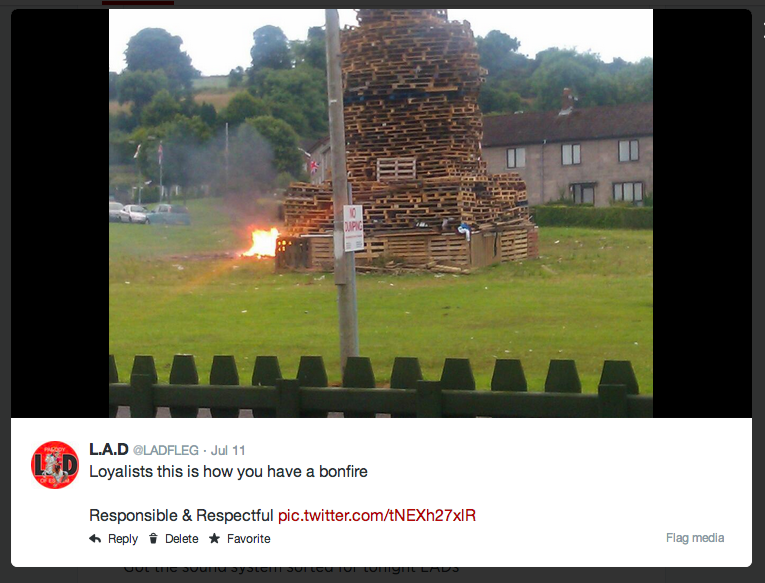
July 11th or as its also known here Bonfire night, saw the alarming introduction of Irish flegs and effigies to the bonfires which youths had spend the previous months constructing in loyalist communities. I spent the morning driving around doing messages before everything shut down for the weekend, and on my way photographed a few bonfires that I happened upon. It was quite sad to see that posters of political parties had been placed along side the Irish flegs and that some even contained what can only be described as racist comments scrawled across make shift banners. For me the most depressing thing I saw were the signs hung on a railing adjacent to the bonfire at Cluan Place on the bottom of the Albertbridge Road which read, "We Stand with Israel" and "Fuck the Gaza Strip". 

For the last number of years I have heard many residents from this little street complain that they continually suffer at the hands of their bigger neighbours from the nearby short strand, I found there dismissal of the current situation in Gaza to be a little ironic. 

It should be noted that these banners were eventually removed after they began to appear on social media. 


In the LAD bunker the eleventh night was a hectic affair, the inbox was jam packed with correspondence from followers documenting the events of the night, it was rather depressing actually as images flooded in showing the worst examples of loyalist culture, leaderless loyalists burning anything that represented those that they perceived to be attacking their culture. Again the irony of attacking somebody's culture, while complaining that your own was under attack appeared to be lost on the many people responsible. 


No need for it really, is there? 

I would however like to take the time to congratulate Ian Shanks and the community at Braniel who celebrated bonfire night without burning anything that could be considered offensive, Im sure that there were other fires across are wee country where this was the case, I don't know Im presuming hoping that they were not hate filled occasions. 


The Braniel Bonfire, East Belfast - Fleg free and still fun

The bonfire at Braniel is an example of what the eleventh night could be for other communities if only they had the same leadership to teach them right from wrong. 

Another alarming thing which happened on the eleventh night were the attempts by  certain republicans (not content with the damage loyalists were doing to there own reputation), to stir things up further and fabricate stories about materials being burned on bonfires which were obviously false. LAD received a couple of images that were clearly photoshopped. It was hard to believe that people would sink so low. It would be unfair for us to be anymore specific and you will all know what I'm referring to, but we hope that the family concerned were not badly affected by these malicious lies.  

I awoke the next morning the twelfth to the sound of a blood and thunder band passing the bottom of my street and to the news I had been been dreading, the planned road trip to Markethill was called off, due to the family becoming struck down with illness. Its FAIR to say I was devastated as I'd been looking forward to enjoying William Frazer's bigoted barbecue since receiving the invitation from him some days earlier. 


You can read an excellent blog by Barton Creeth here about his adventures in Markethill although it appears he skipped the BBQ.  

Undeterred and keen to watch some bands I made my way by foot into Belfast city centre and up towards Clifton Street Orange Hall, from which the Belfast demonstration departs. Security was tight which I guess was to be expected, hundreds of PSNI officers standing around, just in case, but on a wet saturday morning at 9.30am, I reckoned there was little chance of any trouble. 

As I walked along Royal Avenue, I tweeted that the crowds were smaller than I had seen in previous years, a response from the political commentator and alleged doctor David McCann informed me that there were decent sized crowds gathered further up the route. 

Turning left on to Donegal Street, I was stopped by a rather pleasant and chirpy female constable and her male colleague who informed me that I could not proceed past the Irish News offices and would have to take a longer alternative route to arrive at my destination. For a brief second I understood how the Orange Order must feel regarding the parades commission decision at Ardoyne. Those extra meters that I was being asked to walk were after all a massive inconvenience. 


Thou shalt not pass 

I am of course being sarcastic, I respect the law and decisions made by parading bodies and after a friendly conversation with the constables I continued on my way via union street and carrick hill.


PSNI on Union Street 

As I walked past the junction of Trinity Street, I noticed a small group of residents had gathered for what is now their annual protest. I wondered if these people mostly women and children had set their alarm clocks in order to rise early on a saturday morning to register their dismay at what was about to pass the end of the street. 


"Down with that sort of thing" 

At this stage I had lost count of the numbers of police landrovers, they were everywhere and with them vast numbers of police officers, I did think to myself that it was bound to be an expensive morning for the tax payer. Still who needs hospitals and schools and all the other stuff that taxes pay for when you can live in a city where the inhabitants cant learn to get along. 

I saw Paul Clarke off the telly as he and his camera man attempted to capture the atmosphere for that evenings news. He gave me a nod, but I think he mistook me for somebody else. I always find it strange meeting TV people in real life. He looked taller than I had expected. 

The parade started and the assembled press photographers jostled for position in order to grab that picture for the next days newspapers, their cameras were fancier than mine but I was tweeting what I was taking straight away to LAD followers so in effect beating them to an audience. 


 last warning, but is it big enough for all to see?

I skipped the passing of St. Patricks Church by the parade, leaving that to the proper journalists, I had no interest in which band would break the determination set out by the parades commission, although suspected one would. I'm not a big fan of religion and was more interested in people watching. I walked to the bottom of St. Peter's hill and joined the steady stream of spectators who were not trusted to walk past a place of worship and had come into the city centre from the Shankill area. 

By this time the crowds on Royal Avenue had swelled and the street was awash with red, white and blue. There was a real party atmosphere as the spectators awaited the first glimpse of the bands. There was a lot of drinking taking place which many people have commented on, the police seemed to be ignoring it, really what could they do, that hadn't the potential to start a riot.

Don't get me wrong, I enjoy a drink and have been to a number of festivals around the world and have seen similar sights at those, but the one thing that did shock me was the number of young people who were clearly underage who were pissed at 10am in the morning. The rowdy behaviour that was being exhibited by these drunk kids meant I was glad I had left my own kids at home. 


Orangefest 2014 - Fun for all families? 

Continuing on my towards city hall, I stopped to take the obligatory Twelfie 

Does my head look big in this?

The parade stopped at city hall, and a small group at the front consisting mostly of DUP MLA's made their way to the cenotaph for the religious service, William Crawley was there with a documentary crew as the main body of the parade waited patiently for the others to return. At the head of the parade was a group holding a banner which read "LET THEM HOME" which they had most likely carried from their house that morning. 


   The poor displaced sons of Ligoniel - refugees in their own city

While at city hall, I bumped into Alex Kane who was out and about following the procession for an article he was writing for the Belfast Telegraph. We had a chat about LAD, the events of the previous weeks in the build up to the Twelfth and the difference between the city parades and those held in rural towns. You can read his article here

Leaving Alex I continued on past the Ulster Hall towards Shaftesbury Square, the crowds were taking up all of the footpaths which made the journey difficult, already there was quite a lot of litter on the floor and I spotted at least one paramilitary fleg on display. The mood changed too, it felt more aggressive, a little volatile. I imagine most of these people had little sleep the night before having been in attendance at the bonfires which had illuminated the night sky.   I did spot a couple of tourists in the middle of it all who looked rather bemused by what was going on. 

The twelfth is one of those things which will Im afraid always divide no matter what attempts are made to rebrand it by the Orange Order and while I accept that for some people it is the highlight of their cultural year, for others it is not so its important that those leaders who met off the Newtownards Road to sign a pledge, to bring down the parades commission learn to compromise.  

Personally I enjoy the noise and the colour of the bands although the sash tends to be over played throughout the day, I imagine I'd have a difference of opinion with the average Orange man on most subjects but I would urge them to get a handle of the amount of alcohol consumed as it takes away from the spectacle and gives their opponents a big stick with which to beat them. There is also the issue of the mess that is left behind when the parade has passed. These are important issues which need tackled. 

I have to admit that having battled my way along the footpath to the bottom of the Lisburn road, (I must have said excuse me a couple of hundred times) I gave up and headed for home. Next year perhaps I will make it to the field. 


0 comments

 '‘you cannot put a price on culture.’' - Jamie Bryson, interview on Slugger O'Toole http://sluggerotoole.com/2014/03/24/jamie-bryson-a-rebel-without-a-hope/#comments
I'd agree (to a certain extent).

Although, I imagine what passes for Irish Protestant culture in Jamie's eyes differs from mine a tad.

His appears to be wrapped in a Union Flag.

So, what passed for Irish/Ulster Protestant culture before there were such things as the Union Flag/Union, before the paramilitaries, before KTP bands, before the ‘Loyal’ orders or the 12th?
Did we live in some sort of cultural cocoon awaiting the day when we would have something to celebrate or did we have other things to be getting on with?
So I had a dig:


Dancing and fiddling

Of course I had a rough idea about this topic before my half-assed search, my grandparents often spoke of dances down at the Orange hall and they didn’t mean the modern version that sometimes includes some god-awful combo of loyalist anthems, country music and dance (would make yer ears bleed, jeez!).
They were referring to the days of when people would attend social dances at orange halls and dance till daybreak to the music of a melodeon or a fiddle or such like.

My other Granda (a B Special) and his brothers (also B specials) played a full range of folk instruments in their village hall, including some instruments that would now be considered ‘suspect’ or a bit ‘taigy’ e.g. the penny whistle (don’t laugh, you know some of the nutty wans would be offended at a display of something so ‘oirish’).


Fast forward a few decades and there’s hardly any evidence of this.
It’s like there’s been some massive cultural brainwashing.                                                              

Many loyalists would be as blindly ignorant to such goings-on in local Orange halls as Germans neighbouring the various concentration camps of WWII: “what? We heard nahin’”.

For anyone who wants a more qualified and in-depth look at this story I recommend simply looking at some easy to obtain books on Ulster folk culture.

I would like to name a book in particular but as this is a blog for LAD then the more paranoid types would unfairly and uncritically assume that the book is part of the great republican-nationalist-middleclass-Protestant-papist-commie-Chinese-conspiracy and ignore the contents of this book much to their cultural peril.

So, sorry to be vague, but it’s the way of NI’s world: “you have provided proof that we are wrong therefore you are the enemy…”
The author has been looking into this topic for decades and has come up with examples of Orange folk music preservation that have gobsmacked even myself e.g. post-partition Orange halls in County Down were some of the best places to find examples of ‘unadulterated’ Irish folk music on account of their immunity to the influences of the Gaelic League and the Catholic Church (e.g. in the Republic there was a massive overhaul on folk music & dancing and as such house dances were banned, instead dances had to be held in parochial halls with ‘approved’ ceili music).
Orange Halls of Co Down - Home of the craic/crack?
(Image kindly lent by 'How to Start a Fight in an Irish Bar' -
http://howtostartafightinanirishbar.blogspot.com.au/2014_01_01_archive.html )

So, we have the scenario where pro-British Orangemen were dancing to traditional Irish reels and jigs whilst Irish nationalists in neighbouring villages were dancing very much to the tune of something recently contrived, in essence their ‘traditional’ Irish folk dance and music was in fact something very new.
Mental.
Being Northern Ireland I doubt if it was quite so clear cut but it’s certainly something to think about.
So there you have it, Protestants used to sing, dance and make merry in a very traditional Irish manner and latterly the ‘most’ Irish manner (some still do, but it’s almost an ‘underground’ thing).


NOT the 12th
So, what about the 12th of July? Surely that’s been a part of culture for a long time?
Well, yes, but not from the word go as some would suggest.

As most of ye’s know, the Orange Order was formed in 1795 but the celebrations of the British acquisition of the Dutch stock exchange Williamite victory at the Boyne weren’t celebrated for a good while after that. And even then it was mainly an Anglican affair. 

Presbyterians took quite a while to get involved (mid 1800’s roughly speaking), most modern day Presbyterians tend to be quite forgetful regarding the topic of Britain’s attitude and behaviour towards them (Cromwell, the Penal Laws etc…).

Indeed, it’s not a stretch to say that many if not most Presbyterians in the 1790’s were much more concerned with rebelling against the crown than supporting it.


Apprentices: More 'FTP' than YTP?

Apprentice Boys and the Siege of Derry celebrations
Unbelievably (or believably if you have suffered enough of my blogs) this event wasn’t much remembered for a long time and when it did finally make an appearance the first celebrations involved members of the Catholic Church.
Again, a large time gap between the actual event and the celebrations becoming part of a tradition.
Not only that, but a number (if not all) of the original Apprentice Boys spoke some form of Gaelic. Yet more vanished culture.
A respected flag.

So, what about flags?
Well:

Union Flag – Didn’t incorporate Ireland till the 1800’s and it was an unpopular move at the time, so that’s a couple of centuries of doing without it

Ulster Flag – Didn’t come into existence till the 20th century, so that is a relative newcomer.

Independence Flag – Somehow this flag still makes its way into demonstrations by people eager to show their loyalty to an institution that the flag purports to disengage from.
Go figure.
It’s like wearing an IBM or Coca-Cola T-shirt to a Marxist rally…

All in all, the culture of disgracing flags by attaching them to lampposts with gay abandon is something relatively new and perhaps not essential to unionist or Protestant 'culture' after all?

A Gaelic game played by Prods?! Scotland you Lundy!!!!!

Cammanachd
“what?”

I said cammanachd.

The easiest way to describe it would be to think of the Scottish game of Shinty.
Actually, cammanachd is the ancestor of both shinty and hurling, arguably shinty would more closely resemble the old cammanachd on account of its caiman (stick), the hurling stick came from a later summer version of hurling (well, Cammanachd) that gradually supplanted the older version.

Whilst hurling sticks became synonymous with Irish nationalism old Cammanachd (or shinny as it became known) limped on up north, mainly in the Protestant areas.
So there you have it, the last bastion of an old Gaelic game was in Protestant Ulster.

The Old Firm be damned
Other ‘taigy’ activities:

Other suspect activities that were part of Ulster Protestant culture at various points of history include the following points; I’ll only list them as I’ve ranted in greater detail about them previously.

·         Irish/Gaelic

·         Uilleann pipes – Once upon a time they were part and parcel of the culture of ‘gentlemen pipers’ and clergymen

·         Crossroads dancing

WHAT?!!!
·         Bodhran playing - Just like many Protestant folk enthusiasts still do across the water in Scotland 

·         Celebrating St Patrick’s day – Though some still do celebrate it, more are starting to and I THINK there’s an annual Orange parade in Ballymena not to mention Ian Paisley’s enthusiasm for St Pat (he opened his Martyr’s memorial church on St Pat’s day).

It could be argued that those who are arguing most passionately for the preservation of their culture are among the worst offenders with regards to its decline and stagnation.

They have no respect for the old traditions of folk music & dance (resembles ‘Irish’ culture too much), care not a jot for fiddles or ballads, think of the Gaelic languages as ‘foreign’ (despite a tractor trailer load of evidence to the contrary) and would sooner stuff their ears with wax rather than listen to ‘fiddledy dee’ music (unless they’re in Scotland).
Irish music - Taigy (?)


They’re seemingly only interested in preserving their mutant version of Britishness which is not recognised by the majority of folks living in Britain.


Scottish music - Not Taigy (?)
If they put as much effort into preserving the Ulster versions of Gaelic as they do preserving the place of flags in public spaces then Ulster Gaelic would perhaps have less in common with the southern variants.  Who knows, just speculating?


If they had kept up the dancing and fiddling with the enthusiasm they have for marching then perhaps Ulster folk music would not be so ‘Oirish’?

Loyalists and indeed some unionists despise what they see as Irish culture but fail to realise that they are partly responsible for its current incarnation having opted out of its development.

It’s a sad irony for them that Northern Ireland would perhaps be even more culturally detached from the South than it is now had Loyalism not turned its back on its Irish culture.

I’d ask what would happen if loyalism and Orangeism were to re-embrace their lost culture, alas I think I know the answer:

People would see them as ‘Irish’, a price too great for some to pay.

Tragic.

Remember kids, if you're not loyal enough you'll turn into this
10 comments
Hello there. A select few of you may recognise the name at the bottom of this post, and if you do, then you presumably know that I write dick jokes for a living. That’s probably not the most convincing invitation to listen to my political whitterings, but here I am. Hear me out. Coupla minutes, sure.

The wonderful folks at LAD HQ have been gracious enough to allow me to post occasional articles and thoughts on their blog. That's a true honour, and whilst I understand that this blog is primarily a satirical blog, I wish to use my first post here to make a few points that, in light of recent events, need to be said with the utmost sincerity.

Now, before you go off thinking I'll be boring the bollocks off you every time I post, I can promise you that future contributions will be heavily peppered with silliness. For now, you'll just have to make do with this animated .gif of everyone's favourite decrepit tangerine, George Chittick, being smoulderingly sexy:


 "Ye wanna do the bouncy...?"

Anyway, with that out of the way, it's down to business. Here we go.
 
The opening of a new Irish language center in the predominantly Protestant East Belfast is poignant for many reasons; not simply for the obvious, but also as a reflection of a slowly emerging, broader change within the wider Protestant community. As we normalise ourselves within the (admittedly) fragile peace the Good Friday Agreement has given us, we learn more and more that many notions of old are simply that – notions of old.  They are constructs. Antiquated ideas still fed to us by voices from a dark past. Ideas still used as weapons of the mind.


One of these antiquated ideas that I'm talking about is thus: that any promotion of the Irish language and culture is simply a front for the republican agenda towards reuniting Ireland. 

It's easy to understand why this generalisation is still fresh in the minds of many within the PUL community. After all, the extremist republican movement has, in the past, attempted (and in some ways, succeeded) to politicise the language for their own gains – to instate themselves as the purveyors of “true” Irishness. Today, this is perhaps most evident in the suggestion that the most Irish many in the PUL community currently understand is "tiocfaidh ar la.”

Loyalist and unionist hardliners have been happy to indulge this notion themselves, by tarring everything remotely Irish with the same brush of republican terrorism. They do this to galvanise the loyalist cause by promoting a fear of anything Irish within their own community. They, like the hardline republicans, have politicised the Irish language for their own gains also
.

These constructs, meticulously cultivated from both sides throughout recent history, have helped to disguise the true, historical relationship between the Protestant people of the north of Ireland and the Irish language. We'll talk more on that in a bit.


A Foundation For Change


The last 14 months of bully-boy, boo-hoo bellyaching about the “slow dismantling of loyalist culture” in the North from the DUP/Orange Order/loyalist collective have disenfranchised said culture to many Protestants, who, being fed up of what they’ve seen during this period, have perhaps decided to seek out for themselves something else that truly represents them – and why not? 

When we are told by hardliners that hate-fuelled flag burning and antagonism is “our culture,” we feel misrepresented deep in our bones. They say they speak for all of the Protestant people in today's North. They do not. 

When hardline loyalists talk about the idea of Protestant culture being dumbed down, they are blurring lines.  The true question is this – is Protestant culture being dumbed down, or are the negative aspects of loyalist culture being dumbed down? Hardliners may want us to believe the notion that they are one and the same, but they are not. 

Perhaps, in light of recent events, there is an emerging desire for many Protestants to disassociate from the “culture” they have been told over the years is their own, and to find something more positive to connect to. Some, such as those who now attend Irish classes in the Irish Language Center of East Belfast, have looked further back into their lineage and been surprised at what they have discovered.

There is a deep historical relationship between northern Protestants and the Irish language dating back hundreds of years, all the way back to the Ascendancy landowners of the 1700s, who used the language to communicate with their local tenants despite it being outlawed by the English.

The Irish language has been held in dear regard throughout much of Protestant involvement in Ireland: from the United Irishmen, a revolutionary group founded by northern Presbyterians to protect Ireland's interests (and led by the Protestant Wolfe Tone) to the grandfather of modern unionism himself, Edward Carson, who was a fluent Irish speaker and enthusiast.

Even post-partition, the unionist government of the new six-county state were very comfortable in using celtic regalia for their governmental crests and plaques, such as this design for the Parliamentary Library of Northern Ireland:

 Source: Ulster Scot FB page. Willie Frazer would have a fit.

It is this oft-forgotten relationship that many loyalist hardliners wish to keep hidden, as it contradicts their political aspirations. To keep the Protestant community polarised from the Catholic community is to keep the Protestant people where hardliners such as the DUP want them – a place where these zealous individuals can wield the most power and fulfil their own small-minded, bigoted agendas.

As hardliner support in today’s North slowly lessens, and we slowly free ourselves from the constructs of conflict, more and more Protestants are now discovering for themselves once again their Irish roots. 

There is the recent story of Protestant Linda Ervine – developer of the Irish Language Center in East Belfast – who discovered that many in her family, alongside her husband’s family, spoke fluent Irish prior to partition. Perhaps as more Protestants seek to find and discover their own hidden relationship with the language, we will see the true Protestant culture of the North emerge:

A culture that thrives on re-engagement with the proud historical contribution Protestants have made to Irish culture. 

A culture centered on reconciliation with Catholic neighbours via rediscovered common interests, all founded in the principle of peace. 

As the culture of reconciliation becomes more apparent, the less the hardline brand of hate-fuelled “culture” becomes relevant. Eventually, the notions of old will fade away.

This isn’t mere conjecture. As we emerge out of the ashes of the past, we are seeing this change in action through the work of people like Linda Ervine. Perhaps one day we can all, Protestant and Catholic, take a singular pride in our home through a unified sense of cultural wellbeing.

We are, after all, a part of Ireland that is a part of the UK

Protestants must disengage completely from the voices of old such as George Chittick, who bray with fire and brimstone about how engagement with Irish culture is the “slippery slope” towards a United Ireland. A United Ireland is completely irrelevant to this discussion. Irish culture is, after all, as much a Protestant's culture as it is anyone else’s on this island, regardless of the union with Great Britain.

 Perhaps we should take a great pride in this together as one, and perhaps the North can stand tall as a proudly Irish part of the UK. 

I, myself, am from a Protestant background, raised in the very north coast of County Derry. I am a proud Irishman from the North. I am slowly learning to speak Irish myself, and I hope to be fluent someday. 

I invite everyone from a Protestant background in the North to reacquaint themselves with our significant connection and contribution to Irish culture. 

So whaddya say, fellas, fancy joining me on this journey?


To the heinous bigotry that parades itself as “culture,” I hope, some day, we can all say bliain mhaith i do dhiaidh.

Best wishes, 

-Dave McElfatrick
20 comments